
Considerations on Using AI to Rewrite Bioinformatics Tools

What happens when AI starts rewriting the tools bioinformatics depends on?

Last month, members of C3G and the HeDS‑D2R team attended the Canadian Bioinformatics Hub Conference (CBHC) 2026, held over three days at MaRS in Toronto. The meeting brought together researchers from across Canada and, like many conferences this year, was defined by a strong focus on artificial intelligence.

Among those attending was Senthilkumar Kailasam, PhD, a C3G alumnus and now Scientific Data Analyst at HeDS‑D2R. Reflecting on the discussions at CBHC, Senthil was struck not only by how AI is accelerating the development of new bioinformatics tools, but by a quieter shift: its growing role in rewriting the tools the field already depends on. In the think piece that follows, Senthilkumar explores this emerging trend and its implications.

Senthilkumar Kailasam reflects on AI at CBHC 2026

At CBHC this year, it was impossible to ignore the gravitational pull of AI, with keynote addresses, panel discussions, and a small but growing cluster of abstracts presenting AI agents in bioinformatics.

Hamed D. Najafabadi, Associate Professor in Human Genetics at McGill University, and Haibe-Kains, Senior Scientist at the University of Toronto Princess Margaret Cancer Centre, ran a fireside chat with one of the best titles on the schedule: “Do we really need another bioinformatics tool? To build or not to build.” It’s exactly the right question, but there’s a quieter one hiding just behind it, and that’s the one I couldn’t stop turning over: “How do we rewrite the tools we already have, both efficiently and responsibly, with AI?”

Because here’s the thing nobody quite put on a slide: while we debate whether to build new tools, AI coding agents are already quietly rewriting the old ones, such as samtools, fastqc and half of nf-core, in a language most of the room has never compiled a line of. “To build or not to build” assumes you’re starting from a blank file. The rewrite wave doesn’t. It starts from someone else’s twenty-year-old C++ and a prompt that says, “port this to Rust.”

Melanie Courtot, Senior Director of Genome Informatics at the Ontario Institute for Cancer Research, delivered a talk that nailed the adjacent truth: the promise of AI rests on clean, structured, interoperable data, and investing in those basics is a prerequisite for AI to deliver. The same logic applies one layer down; a fast rewrite rests on correctness, and correctness matters just as much.

The Rust ecosystem is already substantial

The Rust ecosystem in bioinformatics has been steadily growing, with several tools now widely used in day-to-day workflows, including:

  • rust-htslib (BAM/VCF/CRAM/HTS bindings)
  • perbase (per-base metrics)
  • pymol_rs (structure visualization)
  • sourmash (sketching and similarity search)
  • varlociraptor (variant calling)
  • alevin-fry and salmon 2.0 (single-cell and transcript quantification)
  • RustQC (sequencing QC)

The question isn’t whether Rust can deliver performance. It clearly can. The harder question is what it takes for a rewrite to earn the same level of trust as the tools it replaces.

What some skeptics say

On the OMGenomics podcast, host Robert Aboukhalil, PhD, argues that rewriting software is nearly always a bad idea, with one narrow exception [2]. Their core point is simple: established tools accumulate years of edge cases. Every weird FASTQ from a dying sequencer, every undocumented workaround someone depended on gets baked in. Even if the tool was written by overworked trainees, that code is now doing critical work for thousands of analyses.

The reported risk isn’t crashes; those are usually caught quickly, but code that is confidently and silently wrong.

Naming Conventions

Using an “_rs“ suffix can make Rust rewrites easier to find, but it can also unintentionally borrow the reputation of the original tool.

This workable rule of thumb can help;

  • If the name refers to a general algorithm (like bwa or minimap2), adding “_rs” is usually fine and uncontroversial.
  • But if the name is a distinct, recognizable tool (like Salmon or Kraken), it’s better to choose a new name and clearly reference the original in the README. That way, you acknowledge the lineage without seeming to trade on an existing project’s reputation.

When a rewrite makes sense

The following criteria come up again and again: rewrite only when you understand the original well enough to tell an essential compromise from an incidental choice.

Salmon 2.0 is a good example of what that looks like in practice. It’s a from-scratch Rust rewrite by COMBINE-lab (the original authors), and its migration guide shows what care looks like [3]:

  • Quant.sf output is unchanged;
  • The new index format rejects old indices with a clear error rather than producing wrong results;
  • Per-transcript parity with the C++ version is reported as ≈0.999, with exact flags documented to reproduce old mapping counts;
  • And removals (e.g. salmon alevin → alevin-fry) are explicit rather than silent.

This is the pattern the skeptics tend to endorse: rewrites done by the people who know exactly which parts of the original code are load-bearing. It’s the same approach Felix Krüger took when rewriting Trim Galore in Rust [4].

Shared principles: rewrites.bio

Seqera (the team behind Nextflow) has turned these concerns into a manifesto [5]. At a high level, the message is straightforward:

  • Credit the original authors
  • Emulate exactly (an “improved” output is a different tool)
  • Be transparent about AI and how it was verified
  • Think big, but validate one function at a time
  • Benchmark on real and edge-case data
  • Build only what you need and fail loudly otherwise
  • Pin versions and document parity

The appeal is clear. In one example, a Rust-based RNA-seq QC pipeline (RustQC) reported being roughly 63× faster than the traditional stack on a 10 GB BAM, saving roughly 1.5 million CPU-hours and about 150 t CO₂e per year at 100k samples [6].

Questions worth thinking about

One question cuts through this debate: How would you know your rewrite is correct, and could you prove it to a skeptic?

“It compiled” and “the badge is green” are confident guesses, but not a validated tool. It’s important to ask the following questions:  

  • Do you understand the original’s essential behaviours?
  • Have you validated on real, awkward data?
  • Does your name help users or borrow a reputation?
  • Have you credited the people you’re standing on?

The Rust is the easy part. The validation always was, is, and will be the hard part.

What this means for C3G

From C3G’s perspective, the shift toward utilizing AI tools reinforces our priority of choosing the tools that improve efficiency in terms of time and computational resources, as well as building better and more reliable workflows. But as rewritten tools become more common, especially those generated entirely or assisted by AI, there’s an added need for caution. Not all rewrites faithfully reproduce the behaviour of the original, even if they promise significant performance gains. The same applies when using AI agents to design pipelines: they may suggest faster or more modern alternatives, but these are often newly rewritten tools whose underlying algorithms may not fully match the originals. In this context, careful validation and informed tool selection become just as important as performance.

References

  1. Canadian Bioinformatics Hub Conference (CBHC) 2026, Bioinformatics.ca. MaRS, Toronto, 27–29 May 2026. https://bioinformatics.ca
  2. Aboukhalil, R. & Nattestad, M. Software rewrites. OMGenomics Podcast. https://youtu.be/0o2XnEBDxrI
  3. COMBINE-lab. Migrating from C++ salmon (≤ 1.12.0) to salmon 2.0 (Rust). salmon repository, MIGRATION.md. https://github.com/COMBINE-lab/salmon/blob/master/MIGRATION.md
  4. Krueger, F. Trim Galore v2 — a Rust rewrite of the original Perl tool. https://github.com/FelixKrueger/TrimGalore
  5. rewrites.bio — Principles for rewriting bioinformatics tools with AI. https://rewrites.bio
  6. Seqera Labs. RustQC — benchmark details. https://seqeralabs.github.io/RustQC/rna/benchmark-details/

Research Spotlight: The Jerry Pelletier Initiative (JPI) for Rare Cancers

Precision oncology has advanced rapidly over the last few decades, with breakthroughs in genetic sequencing, tumour modelling, and RNA therapeutics reshaping how cancers are diagnosed and treated. Yet rare cancers remain underserved, constrained by the limited genomic data resulting from small patient populations.

The Jerry Pelletier Initiative (JPI) is helping tackle this challenge by creating a precision oncology pipeline for early identification and analysis of rare cancers. Led by Principal Investigators Dr. Mark Lathrop and Dr. Morag Park, the initiative is supported by a team of co-investigators and collaborators, including our Tech Dev team at C3G.  


C3G’s Role in building the precision oncology pipeline

C3G’s participation in the JPI project is being led by Vinicius Fava, with contributions from Robert Eveleigh, Mareike Janiak, Jose Hector Galvez, and Julian Martinez. Their work has focused on developing a pipeline for whole‑genome sequencing (WGS) analysis of rare cancers, enabling the reporting of somatic mutations, structural variants, and other clinically relevant and actionable genomic features.

To date, the analysis pipeline has successfully processed 5 rare cancer samples, with an additional 10 scheduled for the year and can generate clinic-ready reports approximately 7 days after sample collection, with the bioinformatics pipeline only taking around 24 hours to run. This allows clinicians to gain insights sooner and more rapidly explore potential treatment options. 

Available through C3G’s GenPipes, the pipeline uses nanopore WGS paired tumour–normal sequencing as input and produces a scientific report developed using feedback from clinicians. It can also provide potential approved therapies through the use of the OncoKB Knowledge Base.

In addition to the WGS pipeline, Vinicius is building a framework to analyze single‑cell long‑read and short‑read datasets. This effort helps determine which technologies best capture features such as transcript isoforms and tumour‑specific gene fusions, information that is crucial for better biological understanding of rare cancers and for informing future targeted therapeutic strategies.

To learn more about the Long Read DNA Sequencing Pipeline on Genpipes 

For more information on the JPI project 

Research Spotlight: Optimal Sequencing Strategies for Human Genome Variant Detection

Designing a sequencing project? A recent Genome Biology study offers a practical framework for choosing the right technologies based on your budget and research objectives.

Accurately identifying every genetic variation in the human genome is essential for both research and clinical applications. This Genome Biology study brings together expertise from the Canadian Centre for Computational Genomics (C3G) (Robert Eveleigh, Jose Hector Galvez, Mathieu Bourgey, and Guillaume Bourque) and the Advanced Genomic Technologies Laboratory (Sarah Reiling and Jiannis Ragoussis) to benchmark state-of-the-art sequencing platforms and variant detection approaches across both small and large variant classes.

Methodology

Using the Genome in a Bottle (GIAB) HG002 reference sample, the team systematically compared short-read (SRS; Illumina, MGI) and long-read (LRS; PacBio Sequel/Revio, ONT R9/R10) technologies against Telomere-to-Telomere (T2T) and Clinically Medically Relevant Genes (CMRG) benchmarks, spanning a range of sequencing depths, genomic contexts, and bioinformatic pipelines.

Findings

Their findings confirm that platform and workflow selection should be driven by research objectives. SRS excels at identifying small variants in well-mapped regions, while LR, particularly PacBio Revio, delivers superior accuracy for structural variants and small variants in complex or repetitive regions, achieving accuracy saturation at markedly lower sequencing depths (20–45×) than short-reads (>60×). 

While SRS remains a practical choice for high-throughput genotyping, LRS provides the resolution required for clinical applications at challenging loci.

Learn More

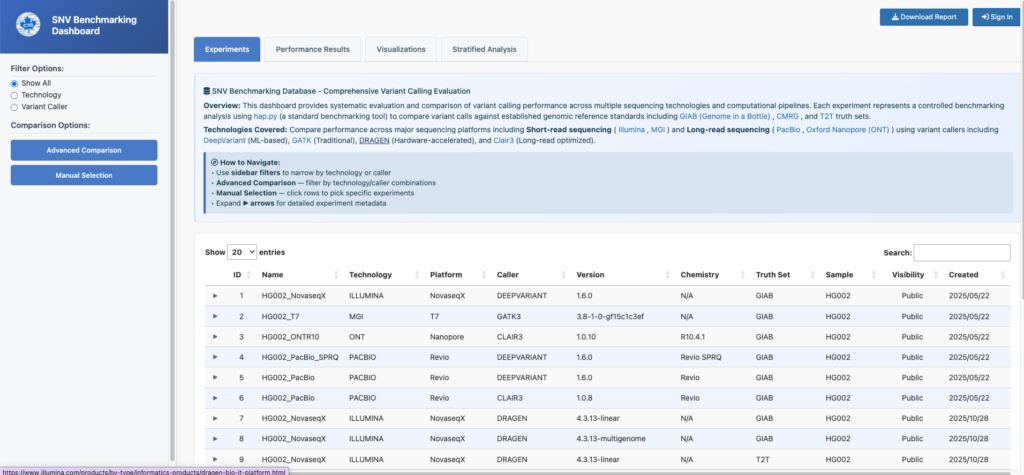
To stay current with the latest algorithms, technologies, and benchmarking practices, C3G also maintains a live dashboard!

Read the full article

Tableau de bord d’évaluation des SNV du C3G

Inside GenPipes: Exploring C3G’s Software Solution for Life Science Research

Take a closer look at one of C3G’s software tools; its purpose, its strengths, its newest features, and how it continues to support the life science community.

What is GenPipes?

GenPipes pipelines provide high-quality genomic analyses optimized for high-performance computing (HPC) and cloud environments. It is an open-source (LGPL), Python-based platform for managing -omics workflows. GenPipes is widely adopted across the life sciences, serving bioinformatics professionals, students, and researchers working on a broad range of genomic analyses and has extensive documentation explaining each pipeline and its outputs to users.

What sets GenPipes apart from other analysis platforms or workflow management systems?

GenPipes stands out for its flexibility, scalability, and ease of use. It adapts quickly to new systems, supports multiple job schedulers and deployment types, and includes a broad set of ready-to-use pipelines. Its integration with the Digital Research Alliance of Canada makes it particularly appealing to Canadian researchers, offering a pre-installed solution for several standard–omics analyses.

GenPipes also has a low barrier to entry; users don’t need to install software, manage reference genomes, or configure compute resources, allowing them to start their analyses quickly and confidently!


What are the most used pipelines in GenPipes?

The most widely used pipelines in GenPipes are ChIP‑Seq, RNA‑Seq, and DNA‑Seq. The DNA‑Seq pipeline supports multiple protocols, making it suitable for both standard whole‑genome analyses and paired cancer genomics workflows. The pipelines output multiple reports and standard files, such as BAM, VCFs, peak-calls and expression matrices.

Does GenPipes have any features to help students and early-career researchers?

Yes! To make GenPipes even more accessible to new users, we developed a new tool called the GenPipes Wizard, with the help of an excellent C3G intern, Alexa Li Kim Wa.

The Wizard is an interactive assistant that helps users:

  • Quickly identify the pipeline best suited to their data
  • Automatically generate the correct command to launch their analysis

What is the most recent version of GenPipes?

We continuously enhance GenPipes based on user feedback and internal benchmarking. Last year’s major release was v.6.1.0, which introduced new pipelines and streamlined the interface by retiring tools that are no longer in use.

Our latest release is a minor update, focused on fixing small bugs uncovered through testing or reported by users. Click the link to learn more about our latest version: v.6.1.1.

If you’d like to help shape future improvements, we encourage users to email us:

pipelines@computationalgenomics.ca

*Users should be aware of whether a release is major, medium, or minor. Major releases may break backward compatibility, which is important for long-running projects that require comparable results. All previous GenPipes versions remain available as modules, so analyses can always be repeated with an older version if needed*

Subscribe to our newsletter to stay up to date on C3G’s latest software releases and updates! 

Anesthesia-related Tweets during COVID-19

Twitter has become a social media nexus for the sharing of information, and in an Anesthesia & Analgesia Journal article published in April 2021, members of C3G’s Toronto Node at SickKids examined the way Twitter was used to share anesthesia-related information during the COVID-19 pandemic.

Continue reading